
Friday, January 28, 2011
Hello
from under yet another 18 inches of snow. This winter is starting to break me. I'm dreaming of beaches and swim-up bars.


Thursday, January 6, 2011
New Year's, Old City
For New Year's Eve Dan and I planned an action packed weekend, which turned out to be a bit too action packed for us.
We woke up early to take a bus to New York Penn Station, and then picked up a train to Boston.
We checked into our hotel, the beautiful Omni Parker House Boston

And quickly headed out to the TD Garden to watch the Celtics play the Hornets.
We had dinner at the Parker House Restaurant (deets over at my flog), and had all intentions of heading out to watch the fireworks at midnight, but sadly the day caught up with us. We took a nap, woke up to watch the ball drop, then spent most of the night watching a Hung marathon on Showtime.
The next morning we headed out to explore the city.


We woke up early to take a bus to New York Penn Station, and then picked up a train to Boston.
We checked into our hotel, the beautiful Omni Parker House Boston

And quickly headed out to the TD Garden to watch the Celtics play the Hornets.
We had dinner at the Parker House Restaurant (deets over at my flog), and had all intentions of heading out to watch the fireworks at midnight, but sadly the day caught up with us. We took a nap, woke up to watch the ball drop, then spent most of the night watching a Hung marathon on Showtime.
The next morning we headed out to explore the city.


Wednesday, December 29, 2010
Very exciting news!
This Christmas we welcomed a new member to our family!
Meet Maxwell Edison

My sister picked up Max when she got a call from her doggie foster group that the local shelter was going to be putting dogs down that night, so she brought Max home on the night before Christmas Eve.
Here he is snoozing with Cousin Mia
So of course we fell in love. He's very sweet and energetic. He's well behaved and, much to my delight, does a two legged "Weekend at Bernie's" walk.

Welcome to the neighborhood Max!

Meet Maxwell Edison

My sister picked up Max when she got a call from her doggie foster group that the local shelter was going to be putting dogs down that night, so she brought Max home on the night before Christmas Eve.
Here he is snoozing with Cousin Mia

So of course we fell in love. He's very sweet and energetic. He's well behaved and, much to my delight, does a two legged "Weekend at Bernie's" walk.

Welcome to the neighborhood Max!

Wednesday, December 8, 2010
Hong Kong Day 3
I only recently learned this about myself, but I am totally a geek for skyscrapers. They're modern and sleek and just really damn cool (although I'm sure Freud would have more to say about this). So, for my final day in Hong Kong, I set out to explore Hong Kong Island and its famous buildings.
It's a little tough getting around Central Hong Kong, everything is uphill, congested, and regular streets can become markets at any given moment, but they are very cool to walk through. Bins of every type of fruit and vegetable imaginable, fish still swimming, unrecognizable meats, clothing, antiques, everything.

1. The Center

The Center the fifth tallest skyscraper in Hong Kong, and served nicely as beacon to help me find my way back to the hotel.
The Center, notable for its arrangement of neon lights which slowly scroll through the colours of the spectrum at night, is one of the few skyscrapers in Hong Kong that is entirely steel-structured with no reinforced concrete core. The reasoning behind this odd, star-shaped building is that it had to fit between its surrounding lots within Queen's Road Central, Jubilee Street, Des Voeux Road Central and Gilman's Bazaar, which were already redeveloped.
2. Jardine House

At the time of its completion in 1972, Jardine House,located at 1 Connaught Place, Central was the tallest building in Hong Kong and in Asia. The building is interconnected with Exchange Square and International Finance Centre by a Central Elevated Walkway.
The building is constructed with a metal frame, and a curtain wall with round windows. It's round windows have earned it the nickname "The House of a Thousand Arseholes."
3. Two International Finance Centre

Two International Finance Centre, completed in 2003, is currently Hong Kong's tallest building, and is quoted as having 88 storeys and 22 high-ceiling trading floors to qualify as being extremely auspicious in Chinese culture. It is, however, short of the magic number, due to the fact that "taboo floors" like 14th and 24th are omitted as being inauspicious – 14 sounds like "definitely fatal" and 24 like "easily fatal" in Cantonese.
It is one of relatively few buildings in the world equipped with double-deck elevators.
4. Bank of China Tower

The Bank of China Tower, located at 1 Garden Road, in Central and Western District on Hong Kong Island is one of the most recognisable skyscrapers in Central, Hong Kong. It houses the headquarters for the Bank of China (Hong Kong) Limited. The building is Designed by I. M. Pei, the building is 1,033.5 ft high with two masts reaching 1,205.4 ft high. It was the tallest building in Hong Kong and Asia from 1989 to 1992, and it was the first building outside the United States to break the 1,000 ft mark. It is now the fourth tallest skyscraper in Hong Kong, after International Commerce Centre, Two International Finance Centre and Central Plaza.
The structural expressionism adopted in the design of this building resembles growing bamboo shoots, symbolising livelihood and prosperity. The whole structure is supported by the five steel columns at the corners of the building, and is covered with glass curtain walls.
While its distinctive look makes it one of Hong Kong's most identifiable landmarks today, it was the source of some controversy at one time, as the bank is the only major building in Hong Kong to have bypassed the convention of consulting with feng shui masters on matters of design prior to construction.
The building has been criticised by some practitioners of Feng Shui for its sharp edges and its negative symbolism by the numerous 'X' shapes in its original design. The building's profile from some angles resembles that of a meat cleaver. In Feng Shui, this is described as a cleaver building and it is not difficult to observe that it is facing the HSBC Hong Kong headquarters building in this guise.
5. HSBC Bank Headquarters

The HSBC Main Building is a headquarters building of The Hongkong and Shanghai Banking Corporation Limited in Central, Hong Kong. It is located along the southern side of Statue Square near the location of the old City Hall, Hong Kong (built in 1869, demolished in 1933).
The new building was designed by the British architect Lord Norman Foster. From the concept to completion, it took 6 years (1979–1985). The building is 180-metres high with 47 storeys and four basement levels. The building has a module design consisting of five steel modules prefabricated in the UK and shipped to Hong Kong. 30,000 tonnes of steel and 4,500 tonnes of aluminium were used. It is rumoured that the building's modular design enables it to be dismantled and moved if there was any possibility of a disrupted handover to the People's Republic of China.
The new Lobby and its 2-part Asian Story Wall were designed by Greg Pearce (also the Principal Architect of the Hong Kong Airport Express (MTR) station). Conceived as a minimalist glass envelope, the new lobby is designed to be deferential to Foster's structure and appears almost to be part of the original.
The main characteristic of HSBC Hong Kong headquarters is its absence of internal supporting structure.
Another notable feature is that natural sunlight is the major source of lighting inside the building. There is a bank of giant mirrors at the top of the atrium, which can reflect natural sunlight down into the plaza. Through the use of natural sunlight, this design helps to conserve energy. Additionally, sun shades are provided on the external facades to block direct sunlight going into the building and to reduce heat gain. Instead of fresh water, sea water is used as coolant for the air-conditioning system.
The Lions:
When HSBC decided to build its third Headquarters at 1 Queen's Road Central, opened in 1935, it commissioned two bronze lions from Shanghai-based British sculptor W W Wagstaffe. This commission was inspired by two earlier lions that had been ordered for the new Shanghai office opened in 1923. These lions had quickly become part of the Shanghai scene, and passers-by would affectionately stroke the lions in the belief that power and money would rub off on them. They became known as Stephen and Stitt: an in-joke. Stephen was named for A G Stephen, formerly Manager Shanghai, and in 1923 the Chief Manager of HSBC, and G H Stitt, the then Manager Shanghai. Stephen is depicted roaring, Stitt quiescent, and again insiders said that this represented the characters of these two famous bankers.
The Hong Kong lions were to be considerably larger, as befitted the Head Office of the Bank.
Like the Shanghai lions, the Hong Kong lions became objects of veneration, and focii of the Bank's perceived excellent feng shui. Young couples still bring their toddlers to stroke the paws and noses of the statues hoping for luck and prosperity.
Aside from a 2-year sojourn in Statue Square aside, the lions have only left their positions as guardians of the Des Voeux Road entrance of the Bank once: they were confiscated by the Japanese and sent to Japan to be melted down. Luckily the war ended before this could happen, and the lions were recognised by an American sailor in a dockyard in Osaka in 1945. They were returned a few months later and restored to their original positions in October 1946.
The Hong Kong lions are also called Stephen and Stitt, and the Hong Kong Stephen has bullet or shrapnel scars in its left hind-quarters dating from the fighting in the Battle of Hong Kong.


6. St. John's Cathedral

St. John's Cathedral located at 4 Garden Road, Central, is the oldest surviving Western ecclesiastical building in Hong Kong, and the oldest Anglican church in the Far East. It was declared a monument in 1996. It is notable that the Cathedral is located at the centre of Powers of Hong Kong as it is surrounded by the Bank of China Tower, HSBC Building (economic), Legislative Council Building (legislative), Central Government Offices (executive) and the Court of Final Appeal (judicial).
The cathedral's architectural style is a plain, unadorned adaptation of 13th century English and Decorated Gothic, which was the popular revivalist style for churches at the time. Along the north wall is a memorial tablet to Captain W.T. Bate RN, who died fighting in Canton.
The bell tower of the cathedral is decorated with a large "VR" on the west face, in commemoration of the institution's founding during the reign of Queen Victoria. The north and south faces of the tower are decorated with the coats-of-arms of two former Governors of Hong Kong, Sir John Davis and George Bonham.
The first pew on the south side of the interior bears the Royal Arms, as it was formerly reserved for the Governor or any member of the Royal Family visiting Hong Kong before the Handover in 1997.
7. Former Supreme Court Building

Now houses Legislative Council
7. Hong Kong Zoological and Botanical Gardens

The Hong Kong Zoological and Botanical Gardens (HKZBG), located on the northern slope of Victoria Peak, occupies an area of 5.6 hectares. Construction works of the Garden started in 1860 and the first stage was opened to the public in 1864.
Apart from the plants, there are over 600 birds, 70 mammals and 40 reptiles, including many different species.
The size of the Garden inhibits the keeping of very large Mammal species such as elephants or giraffes, but nevertheless the collection of primates is varied, including such diverse creatures as the Golden Lion Tamarin, orangutan and Ring-tailed Lemur. The reptiles are primarily snakes and turtles such as the Malaysian Giant Turtle, Chinese Alligator, and Burmese Python.
Birds include the Red-crowned Crane, Flamingo and Peacock Pheasant.

8. Hong Kong Park

The Hong Kong Park is a public park next to Cotton Tree Drive in Central, Hong Kong. It covers an area of 80,000 m² and is an example of modern design and facilities blending with natural landscape.
Hong Kong Park captures the natural landscape in the busy and crowd business centre and provides a relaxing environment. Its main feature is Edward Youde Aviary which is the Hong Kong's largest aviary while the Vantage Point is another great place to see the "bird exhibition". There are also many modern gardens, including Garden Plaza and Tai Chi Garden.


9. The Lippo Centre

The Lippo Centre, previously known as the Bond Center, is a pair of twin office towers in Hong Kong, The buildings are located at 89 Queensway, in Admiralty on Hong Kong Island.
The buildings, completed in 1988, were dubbed "The Koala Tree" because they resemble koalas clutching a tree. The buildings were designed by American architect Paul Rudolph, who strove to relieve the traditional severity of skyscraper walls by designing clusters of obtruding windows.

10. The Hong Kong Convention and Exhibition Centre

The Hong Kong Convention and Exhibition Centre (HKCEC) is one of the two major convention and exhibition venues in Hong Kong, along with AsiaWorld-Expo. It is located in Wan Chai North, Hong Kong Island. Built along the Victoria Harbour, it is linked by covered walkways to nearby hotels and commercial buildings. The original building was built on reclaimed land off Gloucester Road in 1988. The glass curtain was the world's largest at the time, overlooking the Victoria Harbour on three sides.
The second phase of the centre, located on an artificial island, was constructed from 1994 to 1997, and features a bird-like rooftop. The project took only 48 months from reclamation to completion. Originally, Phase Two was connected to Phase One with an atrium link (a sky bridge), and to Convention Road with two road bridges, but now the two phases are connected by an expanded exhibition hall.

11. Central Plaza


Hong Kong Island is dominated by steep, hilly terrain, which makes it the home of some rather unusual methods of transport up and down the slopes.
The Central-Mid-levels escalators is the longest outdoor covered escalator system in the world. The entire escalator system covers over 800 metres in distance and elevates over 135 metres from bottom to top. It was constructed in 1993 to provide a better commute by linking Central and Western District on Hong Kong Island.
Officially opened to the public on 15 October 1993, it has played a very important role in pedestrianising the Western District. It links Des Voeux Road in Central with Conduit Road in the Mid-levels, passing through narrow streets. The daily traffic exceeds 55,000 people, although originally forecast 27,000.
The escalators are 2,600 ft long with a vertical climb of 443 ft. Due to the geographical situation, the same distance is equivalent to several miles of zigzagging roads if travelling by car. It consists of twenty escalators and three moving side-walks. According to Guinness World Records, these escalators together form the longest outdoor covered escalator system.
The escalator daily runs downhill from 6:00 a.m. to 10:00 a.m. and uphill from 10:30am to midnight. Apart from serving as a method of transporting, it is also a tourist attraction and has restaurants, bars, and shops lining its route. There is an entrance and exit on each road it passes, often on both sides of the road.
View from Escalator

13. Man Mo Temple


It's a little tough getting around Central Hong Kong, everything is uphill, congested, and regular streets can become markets at any given moment, but they are very cool to walk through. Bins of every type of fruit and vegetable imaginable, fish still swimming, unrecognizable meats, clothing, antiques, everything.

1. The Center

The Center the fifth tallest skyscraper in Hong Kong, and served nicely as beacon to help me find my way back to the hotel.
The Center, notable for its arrangement of neon lights which slowly scroll through the colours of the spectrum at night, is one of the few skyscrapers in Hong Kong that is entirely steel-structured with no reinforced concrete core. The reasoning behind this odd, star-shaped building is that it had to fit between its surrounding lots within Queen's Road Central, Jubilee Street, Des Voeux Road Central and Gilman's Bazaar, which were already redeveloped.
2. Jardine House
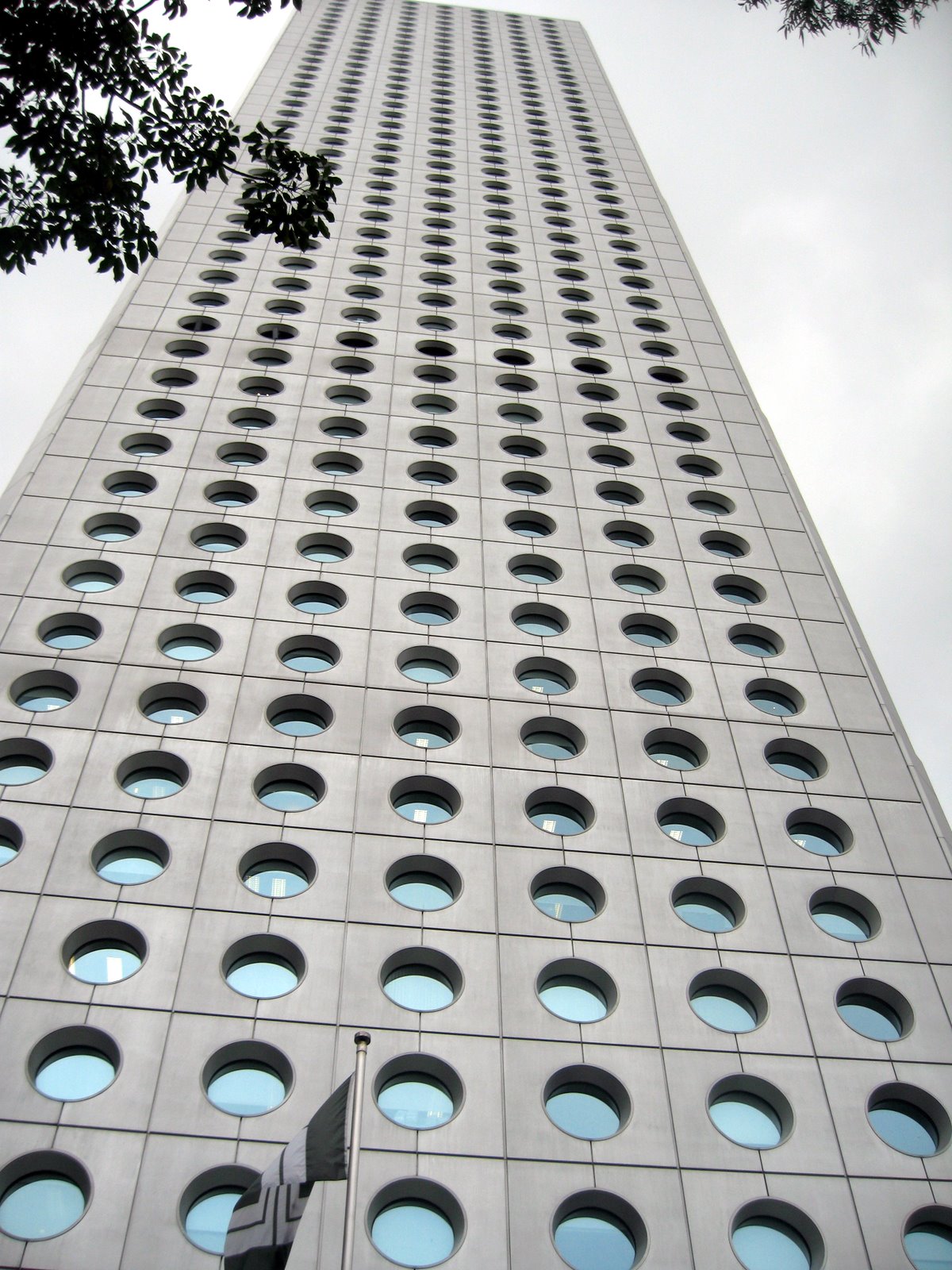
At the time of its completion in 1972, Jardine House,located at 1 Connaught Place, Central was the tallest building in Hong Kong and in Asia. The building is interconnected with Exchange Square and International Finance Centre by a Central Elevated Walkway.
The building is constructed with a metal frame, and a curtain wall with round windows. It's round windows have earned it the nickname "The House of a Thousand Arseholes."
3. Two International Finance Centre

Two International Finance Centre, completed in 2003, is currently Hong Kong's tallest building, and is quoted as having 88 storeys and 22 high-ceiling trading floors to qualify as being extremely auspicious in Chinese culture. It is, however, short of the magic number, due to the fact that "taboo floors" like 14th and 24th are omitted as being inauspicious – 14 sounds like "definitely fatal" and 24 like "easily fatal" in Cantonese.
It is one of relatively few buildings in the world equipped with double-deck elevators.
4. Bank of China Tower

The Bank of China Tower, located at 1 Garden Road, in Central and Western District on Hong Kong Island is one of the most recognisable skyscrapers in Central, Hong Kong. It houses the headquarters for the Bank of China (Hong Kong) Limited. The building is Designed by I. M. Pei, the building is 1,033.5 ft high with two masts reaching 1,205.4 ft high. It was the tallest building in Hong Kong and Asia from 1989 to 1992, and it was the first building outside the United States to break the 1,000 ft mark. It is now the fourth tallest skyscraper in Hong Kong, after International Commerce Centre, Two International Finance Centre and Central Plaza.
The structural expressionism adopted in the design of this building resembles growing bamboo shoots, symbolising livelihood and prosperity. The whole structure is supported by the five steel columns at the corners of the building, and is covered with glass curtain walls.
While its distinctive look makes it one of Hong Kong's most identifiable landmarks today, it was the source of some controversy at one time, as the bank is the only major building in Hong Kong to have bypassed the convention of consulting with feng shui masters on matters of design prior to construction.
The building has been criticised by some practitioners of Feng Shui for its sharp edges and its negative symbolism by the numerous 'X' shapes in its original design. The building's profile from some angles resembles that of a meat cleaver. In Feng Shui, this is described as a cleaver building and it is not difficult to observe that it is facing the HSBC Hong Kong headquarters building in this guise.
5. HSBC Bank Headquarters

The HSBC Main Building is a headquarters building of The Hongkong and Shanghai Banking Corporation Limited in Central, Hong Kong. It is located along the southern side of Statue Square near the location of the old City Hall, Hong Kong (built in 1869, demolished in 1933).
The new building was designed by the British architect Lord Norman Foster. From the concept to completion, it took 6 years (1979–1985). The building is 180-metres high with 47 storeys and four basement levels. The building has a module design consisting of five steel modules prefabricated in the UK and shipped to Hong Kong. 30,000 tonnes of steel and 4,500 tonnes of aluminium were used. It is rumoured that the building's modular design enables it to be dismantled and moved if there was any possibility of a disrupted handover to the People's Republic of China.
The new Lobby and its 2-part Asian Story Wall were designed by Greg Pearce (also the Principal Architect of the Hong Kong Airport Express (MTR) station). Conceived as a minimalist glass envelope, the new lobby is designed to be deferential to Foster's structure and appears almost to be part of the original.
The main characteristic of HSBC Hong Kong headquarters is its absence of internal supporting structure.
Another notable feature is that natural sunlight is the major source of lighting inside the building. There is a bank of giant mirrors at the top of the atrium, which can reflect natural sunlight down into the plaza. Through the use of natural sunlight, this design helps to conserve energy. Additionally, sun shades are provided on the external facades to block direct sunlight going into the building and to reduce heat gain. Instead of fresh water, sea water is used as coolant for the air-conditioning system.
The Lions:
When HSBC decided to build its third Headquarters at 1 Queen's Road Central, opened in 1935, it commissioned two bronze lions from Shanghai-based British sculptor W W Wagstaffe. This commission was inspired by two earlier lions that had been ordered for the new Shanghai office opened in 1923. These lions had quickly become part of the Shanghai scene, and passers-by would affectionately stroke the lions in the belief that power and money would rub off on them. They became known as Stephen and Stitt: an in-joke. Stephen was named for A G Stephen, formerly Manager Shanghai, and in 1923 the Chief Manager of HSBC, and G H Stitt, the then Manager Shanghai. Stephen is depicted roaring, Stitt quiescent, and again insiders said that this represented the characters of these two famous bankers.
The Hong Kong lions were to be considerably larger, as befitted the Head Office of the Bank.
Like the Shanghai lions, the Hong Kong lions became objects of veneration, and focii of the Bank's perceived excellent feng shui. Young couples still bring their toddlers to stroke the paws and noses of the statues hoping for luck and prosperity.
Aside from a 2-year sojourn in Statue Square aside, the lions have only left their positions as guardians of the Des Voeux Road entrance of the Bank once: they were confiscated by the Japanese and sent to Japan to be melted down. Luckily the war ended before this could happen, and the lions were recognised by an American sailor in a dockyard in Osaka in 1945. They were returned a few months later and restored to their original positions in October 1946.
The Hong Kong lions are also called Stephen and Stitt, and the Hong Kong Stephen has bullet or shrapnel scars in its left hind-quarters dating from the fighting in the Battle of Hong Kong.


6. St. John's Cathedral

St. John's Cathedral located at 4 Garden Road, Central, is the oldest surviving Western ecclesiastical building in Hong Kong, and the oldest Anglican church in the Far East. It was declared a monument in 1996. It is notable that the Cathedral is located at the centre of Powers of Hong Kong as it is surrounded by the Bank of China Tower, HSBC Building (economic), Legislative Council Building (legislative), Central Government Offices (executive) and the Court of Final Appeal (judicial).
The cathedral's architectural style is a plain, unadorned adaptation of 13th century English and Decorated Gothic, which was the popular revivalist style for churches at the time. Along the north wall is a memorial tablet to Captain W.T. Bate RN, who died fighting in Canton.
The bell tower of the cathedral is decorated with a large "VR" on the west face, in commemoration of the institution's founding during the reign of Queen Victoria. The north and south faces of the tower are decorated with the coats-of-arms of two former Governors of Hong Kong, Sir John Davis and George Bonham.
The first pew on the south side of the interior bears the Royal Arms, as it was formerly reserved for the Governor or any member of the Royal Family visiting Hong Kong before the Handover in 1997.
7. Former Supreme Court Building

Now houses Legislative Council
7. Hong Kong Zoological and Botanical Gardens

The Hong Kong Zoological and Botanical Gardens (HKZBG), located on the northern slope of Victoria Peak, occupies an area of 5.6 hectares. Construction works of the Garden started in 1860 and the first stage was opened to the public in 1864.
Apart from the plants, there are over 600 birds, 70 mammals and 40 reptiles, including many different species.
The size of the Garden inhibits the keeping of very large Mammal species such as elephants or giraffes, but nevertheless the collection of primates is varied, including such diverse creatures as the Golden Lion Tamarin, orangutan and Ring-tailed Lemur. The reptiles are primarily snakes and turtles such as the Malaysian Giant Turtle, Chinese Alligator, and Burmese Python.
Birds include the Red-crowned Crane, Flamingo and Peacock Pheasant.

I have no clue who this guy is, but I love him!

8. Hong Kong Park

The Hong Kong Park is a public park next to Cotton Tree Drive in Central, Hong Kong. It covers an area of 80,000 m² and is an example of modern design and facilities blending with natural landscape.
Hong Kong Park captures the natural landscape in the busy and crowd business centre and provides a relaxing environment. Its main feature is Edward Youde Aviary which is the Hong Kong's largest aviary while the Vantage Point is another great place to see the "bird exhibition". There are also many modern gardens, including Garden Plaza and Tai Chi Garden.


9. The Lippo Centre

The Lippo Centre, previously known as the Bond Center, is a pair of twin office towers in Hong Kong, The buildings are located at 89 Queensway, in Admiralty on Hong Kong Island.
The buildings, completed in 1988, were dubbed "The Koala Tree" because they resemble koalas clutching a tree. The buildings were designed by American architect Paul Rudolph, who strove to relieve the traditional severity of skyscraper walls by designing clusters of obtruding windows.
(yours truly)

10. The Hong Kong Convention and Exhibition Centre

The Hong Kong Convention and Exhibition Centre (HKCEC) is one of the two major convention and exhibition venues in Hong Kong, along with AsiaWorld-Expo. It is located in Wan Chai North, Hong Kong Island. Built along the Victoria Harbour, it is linked by covered walkways to nearby hotels and commercial buildings. The original building was built on reclaimed land off Gloucester Road in 1988. The glass curtain was the world's largest at the time, overlooking the Victoria Harbour on three sides.
The second phase of the centre, located on an artificial island, was constructed from 1994 to 1997, and features a bird-like rooftop. The project took only 48 months from reclamation to completion. Originally, Phase Two was connected to Phase One with an atrium link (a sky bridge), and to Convention Road with two road bridges, but now the two phases are connected by an expanded exhibition hall.
View of Kowloon Island from the HKCEC

11. Central Plaza

Central Plaza is the third tallest skyscraper in Hong Kong. With a height of 1,227 ft, Central Plaza is only surpassed by 2 IFC in Central and the ICC in West Kowloon. The building is located at 18 Harbour Road, in Wan Chai on Hong Kong Island. It was the tallest building in Asia from 1992 to 1996, until the Shun Hing Square in Shenzhen, People's Republic of China, was built. The 78-storey building was completed in August 1995. The building surpassed the Bank of China Tower as the tallest building in Hong Kong until the completion of 2IFC.
Central Plaza was also the tallest reinforced concrete building in the world, until it was surpassed by CITIC Plaza, Guangzhou. The building uses a triangular floor plan. On the top of the tower is a four-bar neon clock that indicates the time by displaying different colors in 15 minute intervals, blinking at the change of the quarter.
12. Central-Mid Levels Escalators
Central Plaza was also the tallest reinforced concrete building in the world, until it was surpassed by CITIC Plaza, Guangzhou. The building uses a triangular floor plan. On the top of the tower is a four-bar neon clock that indicates the time by displaying different colors in 15 minute intervals, blinking at the change of the quarter.
12. Central-Mid Levels Escalators

Hong Kong Island is dominated by steep, hilly terrain, which makes it the home of some rather unusual methods of transport up and down the slopes.
The Central-Mid-levels escalators is the longest outdoor covered escalator system in the world. The entire escalator system covers over 800 metres in distance and elevates over 135 metres from bottom to top. It was constructed in 1993 to provide a better commute by linking Central and Western District on Hong Kong Island.
Officially opened to the public on 15 October 1993, it has played a very important role in pedestrianising the Western District. It links Des Voeux Road in Central with Conduit Road in the Mid-levels, passing through narrow streets. The daily traffic exceeds 55,000 people, although originally forecast 27,000.
The escalators are 2,600 ft long with a vertical climb of 443 ft. Due to the geographical situation, the same distance is equivalent to several miles of zigzagging roads if travelling by car. It consists of twenty escalators and three moving side-walks. According to Guinness World Records, these escalators together form the longest outdoor covered escalator system.
The escalator daily runs downhill from 6:00 a.m. to 10:00 a.m. and uphill from 10:30am to midnight. Apart from serving as a method of transporting, it is also a tourist attraction and has restaurants, bars, and shops lining its route. There is an entrance and exit on each road it passes, often on both sides of the road.
View from Escalator

13. Man Mo Temple

A Man Mo Temple is a temple for the worship of the civil or literature god Man Tai/Man Cheong and the martial god Mo Tai/ Kwan Tai. The two gods were popularly patronized by scholars and students seeking progress in their study or ranking in the civil examinations in the Ming and Qing dynasties. There are several Man Mo Temples in Hong Kong.
The largest Man Mo Temple in Hong Kong is located at Nos. 124-126 Hollywood Road, in Sheung Wan. It was built in 1847. The Man Mo Temple, the main building of the complex, is dedicated to the civil god Man Cheong and the martial god Kwan Ti. Lit Shing Kung is for the worship of all heavenly gods. The temple was graded as a Grade I historic building in 1993 and it is now a declared monument.
The largest Man Mo Temple in Hong Kong is located at Nos. 124-126 Hollywood Road, in Sheung Wan. It was built in 1847. The Man Mo Temple, the main building of the complex, is dedicated to the civil god Man Cheong and the martial god Kwan Ti. Lit Shing Kung is for the worship of all heavenly gods. The temple was graded as a Grade I historic building in 1993 and it is now a declared monument.
And, were now about at the end of my journey. After Man Mo I dragged myself back to the Hotel (only stopping at Tai Cheong Bakery for an egg tart). I snacked, rested and then Dan and I went out to dinner in Lan Kwai Fong (Hong Kong's party district).
It was a very long, short trip. I managed to see almost everything on my lists. The only thing I didn't get to do was ride on the Ding Ding (Hong Kong's famous double decker trams). I had plenty of opportunity to, but couldn't figure out how to get on the damn thing.

Well, that's it. I hope you enjoyed my trip as much as I did.
Tuesday, December 7, 2010
Hong Kong Day 2
My second day in Hong Kong again started with breakfast with Dan at the coffee shop.
From there I took the MTR to Kowloon, located on the edge of the mainland of China and just across the water from the central part of the city of Hong Kong.
Nathan Road the main thoroughfare in Kowloon, runs in a south-north direction from Tsim Sha Tsui to Mong Kok. It is lined with shops, restaurants and tourists.


I stopped to visit the infamous Chungkign Mansions. The building is well known as some of the cheapest accommodations in Hong Kong.
 The Peninsula Hong Kong is one of the most internationally recognizable hotels in Hong Kong. Opened in 1928, it is Hong Kong's most historical hotel. It is located at the junction of Nathan Road and Sasilsbury Road. The Peninsula has been voted the world's best hotel on several occasions, and is widely regarded as one of the region's legendary properties.
I continued further towards the Victoria Harbor Waterfront, to the Clock Tower.

The promenade provides an impressive view of the Hong Kong skyline and the numerous ships gliding up the channel.


I traveled down the promeade to the Hong Kong Museum of Art (free admission on Wednesdays!). Built to preserve the cultural heritage of China, its collections number in excess of 15,000 art objects, including Chinese paintings and calligraphy works, antique Chinese treasures, paintings of historical significance as well as creations by local artists.
I most enjoyed a special exhibition, “The Ultimate South China Travel Guide – Canton”, an exhibition in the style of a travel guidebook, in which historical information in art works in reflect the golden era of China trade and the history of “export art” during the Qing dynasty.

I headed back up Nathan Road to Kowloon Park.

Located in the central zone of Tsim Sha Tsui, Kowloon Park is one of the largest parks in Kowloon, covering an area of about 13.5 hectares (about 33 acres). It is said to be the 'green lung' at the centre of city.
The park was opened by the then Governor, Sir David Trench on June 24th. In 1989, it was rebuilt, funded by the former Royal Hong Kong Jockey Club at a cost of about HK$300 million.
The park was built in a classical Chinese style, with an attractive variety of rarely-seen beautiful birds and flowers.
The park boasts an abundance of scenic spots and enough establishments for tourists to enjoy themselves. The scenic spots mainly include the Maze Garden, Color Garden, Chinese Garden, Roof Gardens, Banyan Court and Bird Lake.
After the Park, I admittadly got lost, and decided to end my day early and go back to the hotel. I napped and waited for Dan, and we took the Star Ferry back across Victoria Harbor to watch The Symphony of Lights.
The Symphony of Lights is a synchronised decorative light and laser multimedia display, featuring 44 buildings on both sides of the Victoria Harbor, accompanied by music. The technology was developed by Australian firm Laservision and cost approximately HK44 million It has attracted over 4 million visitors and locals so far.
Guiness World Records has named A Symphony of Lights the world's largest permanent light and sound show.

After the show, we took the very back to Hong Kong island, and ate dinner at "Celebrity Cusine", our Hotel's restaurant.
From there I took the MTR to Kowloon, located on the edge of the mainland of China and just across the water from the central part of the city of Hong Kong.
Nathan Road the main thoroughfare in Kowloon, runs in a south-north direction from Tsim Sha Tsui to Mong Kok. It is lined with shops, restaurants and tourists.

Nathan Road
Kowloon’s ‘Golden Mile’, (named after former Sir Matthew Nathan) is a bit of a traffic- and pedestrian-choked scrum of electronics shops and tenement blocks. It is nonetheless an iconic Hong Kong scene stacked with seedy guesthouses awkwardly rubbing shoulders with top-end hotels, touts selling ‘copy’ watches and tailors plying their trade on street corners. If that makes it sound edgy, in reality it is completely safe.

I stopped to visit the infamous Chungkign Mansions. The building is well known as some of the cheapest accommodations in Hong Kong.
Chungking Mansions features guesthouses, curry restaurants, shops and foreign exchange offices. It often acts as a large gathering place for some of the ethnic minorities in Hong Kong.
The building's infamy is fueled by tales both tall and true of conflagrations, crimes and unclaimed bodies. The entrance to Chungking Mansions is via Chungking Arcade, a parade of shops that faces Nathan Rd.
I then headed south, back down Nathan Road towards the Victoria Harbor Waterfront and Chungking's polar opposite, the Peninsula.

I continued further towards the Victoria Harbor Waterfront, to the Clock Tower.

The Clock Tower is a landmark in Hong Kong, located on the southern shore of Tsim Sha Tsui, Kowloon. It is the only remnant of the original site of the former Kowloon Station on the Kowloon-Canton Railway. Officially named Former Kowloon-Canton Railway Clock Tower, it is usually referred to as the Tsim Sha Tsui Clock for its location.
Built out of red bricks and granite, the Clock Tower peaks at 44 metres, and is topped by a 7-metre ligtening rod.
The Clock Tower has been listed as a declared monument in Hong Kong since 1990.
The promenade provides an impressive view of the Hong Kong skyline and the numerous ships gliding up the channel.


The recently opened Avenue of the Stars, built along the promenade outside the New World Center, is modeled on the Hollywood Walk Fame. It honors the most illustrious people the Hong Kong film industry has produced over the past decades.

I traveled down the promeade to the Hong Kong Museum of Art (free admission on Wednesdays!). Built to preserve the cultural heritage of China, its collections number in excess of 15,000 art objects, including Chinese paintings and calligraphy works, antique Chinese treasures, paintings of historical significance as well as creations by local artists.
I most enjoyed a special exhibition, “The Ultimate South China Travel Guide – Canton”, an exhibition in the style of a travel guidebook, in which historical information in art works in reflect the golden era of China trade and the history of “export art” during the Qing dynasty.

I headed back up Nathan Road to Kowloon Park.

Located in the central zone of Tsim Sha Tsui, Kowloon Park is one of the largest parks in Kowloon, covering an area of about 13.5 hectares (about 33 acres). It is said to be the 'green lung' at the centre of city.
The park was opened by the then Governor, Sir David Trench on June 24th. In 1989, it was rebuilt, funded by the former Royal Hong Kong Jockey Club at a cost of about HK$300 million.
The park was built in a classical Chinese style, with an attractive variety of rarely-seen beautiful birds and flowers.
The park boasts an abundance of scenic spots and enough establishments for tourists to enjoy themselves. The scenic spots mainly include the Maze Garden, Color Garden, Chinese Garden, Roof Gardens, Banyan Court and Bird Lake.
After the Park, I admittadly got lost, and decided to end my day early and go back to the hotel. I napped and waited for Dan, and we took the Star Ferry back across Victoria Harbor to watch The Symphony of Lights.
The Symphony of Lights is a synchronised decorative light and laser multimedia display, featuring 44 buildings on both sides of the Victoria Harbor, accompanied by music. The technology was developed by Australian firm Laservision and cost approximately HK44 million It has attracted over 4 million visitors and locals so far.
Guiness World Records has named A Symphony of Lights the world's largest permanent light and sound show.

After the show, we took the very back to Hong Kong island, and ate dinner at "Celebrity Cusine", our Hotel's restaurant.
Subscribe to:
Posts (Atom)


